1. Core Applications
- Consumer Daily Use: Used in storage boxes, decorative ornaments, and household organizers—leveraging its transparency and lightweight feature to blend functionality with aesthetics.
- Commercial Display: Applied in product display stands, light boxes, and retail signage. Its high light transmittance ensures clear product presentation, boosting brand visual appeal.
- Industrial Auxiliary: Utilized for equipment observation windows, component covers, and protective shields. Its moderate impact resistance meets basic industrial safety requirements.
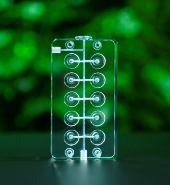
2. Inherent Pros & Cons
Pros
Superior Transparency: Offers excellent light transmittance, comparable to glass, while being lighter (about 50% of glass weight), reducing installation and transportation costs.
Strong Moldability: Easily shaped into complex forms (e.g., curved panels, irregular structures) via cutting, engraving, or thermoforming, adapting to diverse design needs.
Good Weather Resistance: Resists yellowing and degradation under normal outdoor conditions, maintaining performance for extended periods (vs. traditional plastics).
Cons
Limited High-Temperature Resistance: Softens at relatively low temperatures (around 80-100℃), restricting use in high-heat environments (e.g., near heat sources).
Moderate Scratch Resistance: Prone to surface scratches without special treatment, requiring additional coating for high-wear scenarios.
3. Our Processing Advantages
- Precision Customization: Equipped with 5-axis machining centers, we achieve tight control over complex shapes (e.g., seamless joints, micro-scale engravings), addressing acrylic’s "difficulty in high-precision forming" issue.
- Defect Mitigation: Our constant-temperature workshops minimize material deformation during processing, while anti-scratch and anti-yellowing coatings enhance acrylic’s durability—offsetting its inherent weaknesses.
- Efficient Adaptability: With 20 years of experience, we quickly match processing schemes to different application scenarios (e.g., flame-retardant treatment for industrial parts, UV-resistant coating for outdoor displays), maximizing acrylic’s suitability.
Acrylic’s value lies not only in its inherent properties but also in targeted processing. Our capabilities—precision, defect mitigation, and scenario adaptability—turn acrylic’s strengths into practical advantages while minimizing its limitations, providing clients with cost-effective, high-performance acrylic products across sectors.